Posts

Training: "Leave it" in 5 Steps

Image
"Leave it" is a training skill that could potentially save your dog's life. Before you start to train your dog on how to leave something on the ground, it's best that they have already mastered "sit" and leash walking . Below, I have outlined how to teach your dog how to "Leave It", but first I would like to explain how to go about teaching your dog this skill: 1. Only teach your dog a new skill for about 15 minutes a day in 5 minute sessions. "Leave it" is a good skill to practice during commercial breaks. 😏 If you go all hard core on the training and do more than 15 minutes a day in 5 minutes sessions, you risk over saturating your dog and stressing them out.... or they will just become plain ol' bored with the task and not listen to you. 2. In my steps, you will see "P/R". This means "Praise and Reward". Praise= a "good job" or "good boy/girl!" with lots of happy enthusiasm. Reward= a tr...

Dog Breed Personalities

Image
In the past, I have written about choosing a pure bred vs. a shelter dog , how to choose a shelter dog and how to choose a dog breeder . But, I have yet to write in  more detail about dog breed personalities and traits. I am not saying that every individual dog of a specific breed is basically a clone of another of the same breed. As all dog owners know, individual dogs will have their own quirky personality specifically for them. What I am saying is that when choosing a dog breed, you must know historically why that dog was bred. Once you have that gem of knowledge, understanding why your dog does what it does will help you ease a lot of training frustrations. After all, some things may just be a bit more hardwired into your dog than you think. There are seven main dog breed groups in the dog world: Herding, Hound, Sporting, Terrier, Toy, Working and "non-working" (Basically, anything that doesn't fit into a nice tidy category). I provided examples of breeds for ea...

Heartworms in Dogs

Image
A heartworm is a parasitic worm that is transmitted by mosquitoes to your dog. It is easy to prevent, but can be difficult and costly to cure. Your dog can become infected when bit by a mosquito that is infected with the heartworm larvae. There is no way you can detect if a particular mosquito is infected, but it only takes a bite from ONE infected mosquito for the larvae to be transmitted to your dog. Once the larvae has been transmitted to your dog, it takes about 7 months for it to mature into an adult heartworm. These little buggers travel through your dog's body and lodge into the heart, lungs and blood vessels to reproduce. Adult worms can get up to about a foot long and can live 5-7 years reproducing and causing permanent damage inside of your dog. A dog can get up to 250 worms inside there body! YUCK. If left untreated, the infestation will eventually kill your dog in a not so nice way. Luckily, there are readily available preventatives you can give your dog in the f...

How Much Sleep Does a Puppy Need?

Image
So you got a new puppy and for most of the day this little fur ball is the cutest thing in the world. But during particular times of day, your little wiggly butt turns into a beast of incessant barking and biting. Let's face it, those puppy teeth HURT. So what's up with that? Chances are, your puppy is tired and overstimulated. Puppies need A LOT of sleep, and I mean A LOT. Dog's sleep more than humans (lucky them), but a puppy needs more sleep than most people think. The younger the puppy, the more sleep they will need. A newborn puppy will sleep about 22 hours a day and use the rest of it's time for things like nursing. At 3-months, your puppy will need about 15-20 hours of sleep a day. This sleep is crucial for body development. Things like: building muscle, brain development and improving the immune system. If your puppy does not get enough sleep, you get a cranky, destructive teeth chomper that is at risk for infections and illness. NOT GOOD. The problem is th...

Free Or Scheduled Feeding For Your Dog?

Image
 How often and how much should you be feeding your dog? There are two schools of thought when it comes to mealtimes: Free feeding or scheduled feeding. Both have pros & cons and it really depends upon  your lifestyle as well as your dog's personality & health. Which ever way you feed your dog, it is important that you are feeding them a high quality dog food that is recommended for your dog's specific breed. It is also recommended that you only feed the recommended daily amount to avoid obesity .  Free Feeding Free feeding is easier on the owner, for sure. You don't have to worry about getting home at a specific time to feed your dog. Believe me, animals are creatures of schedule. They know when dinner time is right down to the second. Free feeding is also good for active pets and puppies that need the extra calories.  The downside of free feeding is that there is an increased risk for obesity if you do not monitor how much food your dog is getting in a day. ...

Hypothermia in Canines

Image
Hypothermia is a dangerous drop in body temperature and can be caused by more than just being outside in the cold for long periods of time. There are a lot of factors that play into whether or not your dog is at risk of hypothermia, some of them include: Very young or old dogs. Dogs under anesthesia. Smaller breeds, because they experience faster loss of body heat.  Diseases of the hypothalamus (example: hypothyroidism). The hypothalamus is responsible for regulating and maintaining body temperature.  Shock And... of course... if your dog has been out in the cold or the skin/ fur has been wet for a long period of time. So, how do you know if your dog has hypothermia? A dog's normal body temperature is higher than a human's. The normal range is from 101-102.5F. When it drops to a human range of body temperature (97.6- 99.6F), they are in danger of hypothermia. In fact, if your dog's body temperature drops below 98F, you should seek a veterinarian immediately. ...

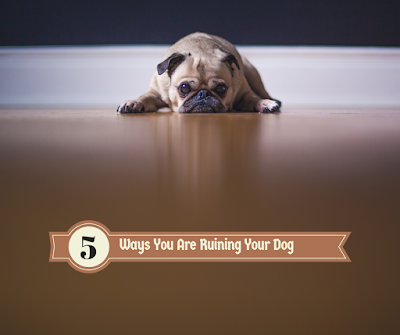
5 Ways Your Are Ruining Your Dog

Image
I've already written about 8 Things That Drive Your Dog Crazy , Top Ten Rules For Children Around Dogs and Why Socializing Your Dog With Other Dogs is Important . All of these are important topics to raising a well-rounded, balanced dog. But, one topic I have yet to write about are human behaviors that are downright ruining the dog. There are many of these behaviors, but I will just focus on the five most prevalent: Yelling at an aggressive / barking dog : This just doesn't work, because your dog doesn't speak human. Dogs that are barking excitedly or fearfully are stressed out. When you yell at them while they are barking, you are just adding to the stress which ultimately leads to more barking. They basically think, "Oh, hey! Now I have my human barking too! Yes!" A better idea is to distract your dog from whatever is causing the barking with their favorite game. OR, even better, teach your dog how to bark on command. I know this seems counter intuitive, ...